Why the thing you’re blaming might not be the thing that’s broken
This piece was originally published in Substack on March 13, 2026.
When something goes wrong in a growing business, we tend to balme the person. The manager isn’t strong enough. The employee wasn’t the right fit. We need better hiring. Our teams need more training. We need someone who just “gets it.”
Sure, sometimes that’s true. But what about the process?
This distinction matters because when you continue to solve a structure problem by replacing people, you’ll continue getting the same result with a different cast.
What a structure problem actually looks like
Challenges with growth are exponential. Here’s a common pattern:
Your business grows from two locations to five. The first two were hard but manageable. You were present and standards traveled because you did. By location four and five, you can’t be everywhere. The locations you don’t visit as often start drifting (Think of that one outlier location that’s two hours away from the others).
Different energy. Different accountability. Managers handle the same situation differently across locations. Complaints that should stop on the floor escalate and you get that 9pm (or 9am) call.
Our instinct is to look at the managers. Who’s weak? Who needs to be replaced?
But when we look closer, we might see that the managers weren’t given any framework for making decisions. This is important, because the way decision are made varies from one company to the next.
Maybe the manager wasn’t set up with clear hiring criteria, so they hired on gut feel. Or they weren’t given an onboarding structure, so new hires figured it out on their own. A lot of times, it’s as simple as managers were never told where their authority begins and ends. In these cases, some managers will default to making all decisions on their own and other managers will default the opposite and escalate every issue.
The result:
It feels like a different company depending on who’s working or what location you visit.
Expectations vary which means service to your customers varies.
Inconsistencies in how employe issue are handled increases risk.
Why is the people diagnosis so persistent?
The short answer: it’s psychological. There is a recognized phenomenon in behavioral science called blame psychology, and several things are at play:1
Attribution theory: how we interpret and explain events; specifically, our successes and failures.
Self-serving bias: our tendency to protect our own egos when things go wrong.
Cognitive dissonance: the discomfort we feel when what we believe and how we act differs.
OK, so it’s not this simple, the mind is complex. The point is that our knee-jerk reaction to blame a human for something not working perfectly is actually quite human.
Within the context of business and work, the people diagnosis persists because it’s visible and immediate. A manager makes a bad decision, you see it because the result is an unhappy employee, a lost client, or lost revenue, and sometimes all three. A new hire leaves after three weeks and everyone feels it because others have to pick up that extra work.
The problem is the structural gap that caused both of these things is invisible and it was not created by a single moment or event. It accumulated quietly over months or years of growth without infrastructure to match. Identifying that gap is key.
What structure actually fixes
When I talk about structure, I don’t mean more policies. Policies describe what should happen, but they don’t guarantee enforcement because they don’t build the habit.
When I talk about structure, I’m thinking about the system that makes the right action the obvious action, regardless of which manager is on shift, which location you’re at, or whether the owner is in the building. The question I’m asking is, “What can we put in place that is Repeatable, Standardized, and Scalable?”
What this looks like in practice:
A hiring process with clear decision criteria so managers stop hiring on vibes alone.
An onboarding process with concrete steps, clear handoffs, and real checkpoints. New hires know what’s expected and managers know who’s responsible for what (e.g., who grants system access, who sends the welcome email, who greets the new hire on Day 1).
Defined manager expectations so the supervisor at the Main Street location handles a no-call/no-show the same way the supervisor at the Front Street location does (without calling you first).
This structure provides guardrails for decision making, steps to common processes, and fairness in how issues are handled. (check out Structural DebtTM for more on this topic)
Now what?
If you’re feeling the strain of constant turnover, inconsistency across locations, your phone lighting up after hours with questions that shouldn’t require you, first ask:
“What system do we have for our people to work within?”
If the honest answer is “not much” or “we have policies, but…” you’re likely facing a structure problem. And that’s ok, because structure problems are solvable.
Let me give you two concrete examples you could implement in your business today. These are versions of processes I’ve used successfully with clients; customize the steps and tasks to fit your company.
Example 1: Hiring: A Process with Guardrails
A common structure gap I’ve seen in growing businesses is the hiring process changes from one hire to the next or it depends on what you’re hiring for or who is doing the hiring.
The manager wants someone who “fits the culture.” They hire on “vibes”, the person who feels. We all love good vibes, but they don’t make a great hiring strategy because six months later, you have a team full of people who felt right but can’t do the job or who do the job fine but are fundamentally misaligned on expectations.
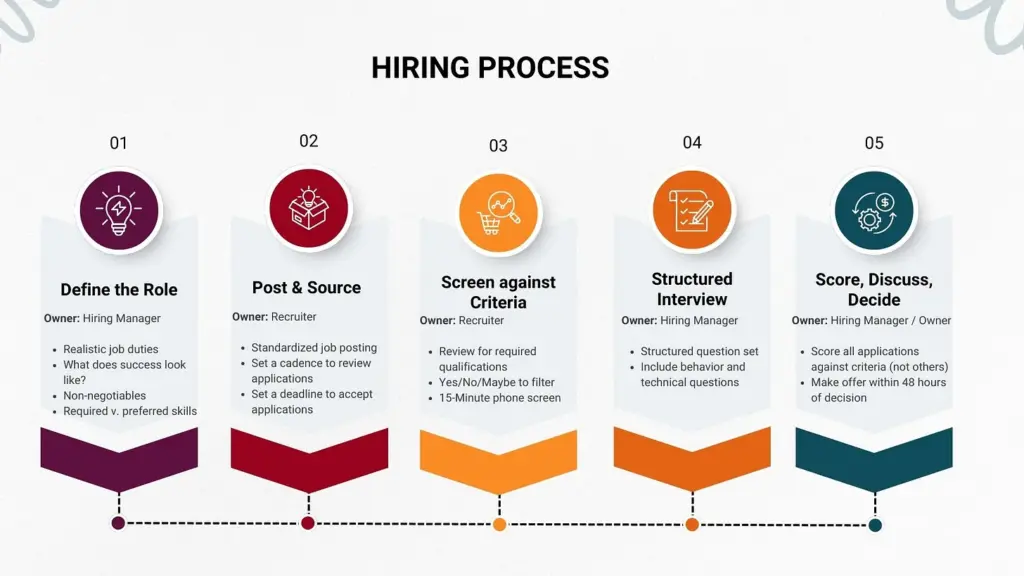
So, we go into knee jerk reaction and start adding screening questions to the application and reposting the job for another round of interviews. Unless we define what it is we are looking for and put a specific process to it, we’ll keep hiring on vibes. Here’s a simple five-step hiring process that creates consistency across locations and managers:
A few things to notice in this process:
The criteria are defined before anyone is interviewed, not as you go along and not after.
Every manager asks the same questions and evaluates against the same standards.
There’s a clear owner at each stage, so nothing falls through the cracks.
The “go/no-go” decision happens at defined checkpoints using defined criteria, not on a gut feel.
A process will make hiring consistent, provide the decision-making guardrails for managers, speed up the process, and help you pinpoint process breakdowns if something doesn’t go right.
Example 2: Escalating Decisions: Know What You Own
The second structure gap I see, and the one directly connected to that 9pm phone call is unclear decision authority.
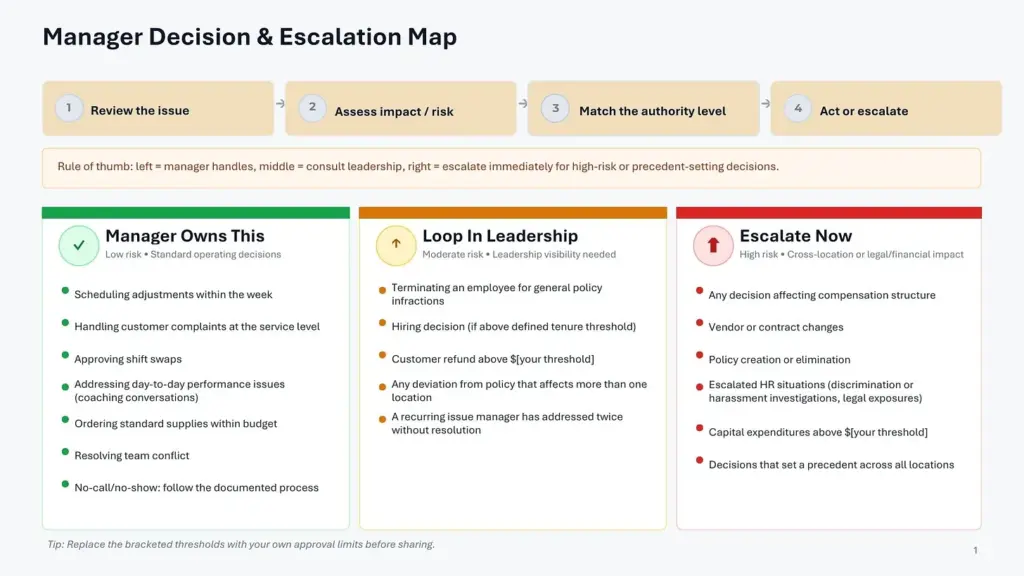
When managers don’t know where their authority starts and stops, two things happen: they over-escalate (calling you for things they should handle), or they under-escalate (making decisions that weren’t theirs to make). Both are painful. Both can lead to much larger issues and risk. And both are fixable.
What works is a decision authority framework. This is not a policy of what should happen but a practical guide that tells everyone in the company: Here’s what you own.
This is where your level set the expectations, get everyone on the same page, and start to standardize. Again, customize this to fit into your company.
Try this: Print the framework. Walk through it with your management team. Ask: “If this situation happened tonight, who would handle it?” The answers will tell you exactly where the gaps are.
The Bottom Line
The next time you’re facing a people problem, pause before defaulting to replacement or retraining. Ask a different question first:
“Did we give that person a structure that set them up to succeed?”
If the answer is no or if you’re not sure, you have your answer. The next step is finding out where the gaps actually are. The people operations diagnosticmaps exactly where structure is missing in your business, so you stop diagnosing people problems that aren’t actually people problems.
Frequently Asked Questions
Is this a people problem or a process problem?
A useful test: does the same situation get handled differently by different managers, in different locations, or on different days? If yes, it’s almost always a process problem — even if the most visible symptom is one person’s decision. Process problems are also more common than people problems in growing businesses, because process rarely scales as fast as headcount.
What is a decision authority framework?
A documented map of which decisions belong to managers, which require escalation, and which sit with ownership. It removes the guesswork operators currently navigate by gut. The simplest version is a one-page list — every recurring decision in your business, who owns it, when to escalate. More mature versions use a RACI (Responsible, Accountable, Consulted, Informed) matrix.
Won’t a process framework make the business too rigid?
This is the most common pushback, and it’s the opposite of what happens. Structure creates predictability, which actually frees managers to use judgment within the boundaries they own — instead of guessing whether each decision is theirs to make. It’s the absence of structure that creates rigidity, because everyone has to wait for the owner to weigh in.
When is it actually a people problem and not a process problem?
When a fully documented, well-trained manager consistently chooses not to follow the documented process. That’s a people problem. But that’s far less common than the diagnosis suggests — most “people problems” disappear once the process behind them is built and taught. The test is whether the same person, in the same role, executes consistently when the process is clearly defined.
1 The Psychology of Blame: Understanding Deflected Responsibility
About the author
Colleen Moore is the Founder and Principal of Moore Consulting LLC, a fractional HR consultancy serving multi-location and franchise operators with 20 to 300 employees and no internal HR. In 2026 she was awarded the American Business Awards Bronze Stevie for HR Executive of the Year. Based in Denver, Colorado.